• Duration:30 Nights 31 Days
  • Max. Altitude: 7134m
  • Group Size: 2-6
  • Activity: Trekking & Climbing
  • Pick Up: TIA Airport

About Tilicho Peak Expedition

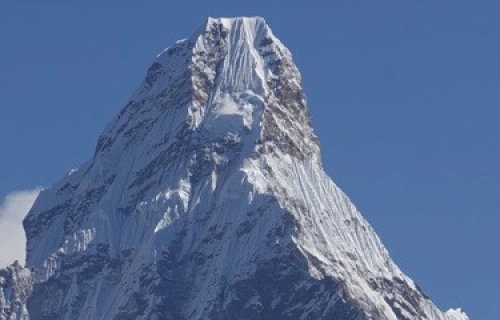
Tilicho Peak is a challenging but straightforward climb. Tilicho Peak Base Camp sits on the shore of the aqua-blue Tilicho Lake.Tilicho Peak is technically interesting as the standard route via the northwest shoulder has mix of rock and ice leading up to steep snowfields.Tilicho Peak has little objective danger because the shoulder is very wide.The summit view is breathtaking: Annapurna massif, Dhaulagiri, Tibetan plateau and below, the deepest valley in the world the Kali Gandaki valley and Tilicho Lake.

In 1950, a French expedition led by Maurice Herzog went to Nepal to look for an approach to ascend Annapurna I. At Tilicho Lake they found a tremendous wall of rock an ice between them and the Annapurna I. In fact, it was a shoulder of rock and ice that extends in a north-northwest direction for 11km, and finally drops down into Tilicho Lake.They named it “la grande barriere” the great barrier. Tilicho Peak is located at the end of Great Barrier, high above the glacial Tilicho Lake. It was climbed for the first time by French climber Emanuel Schmutz via the Northwest shoulder which remains the standard climbing route.

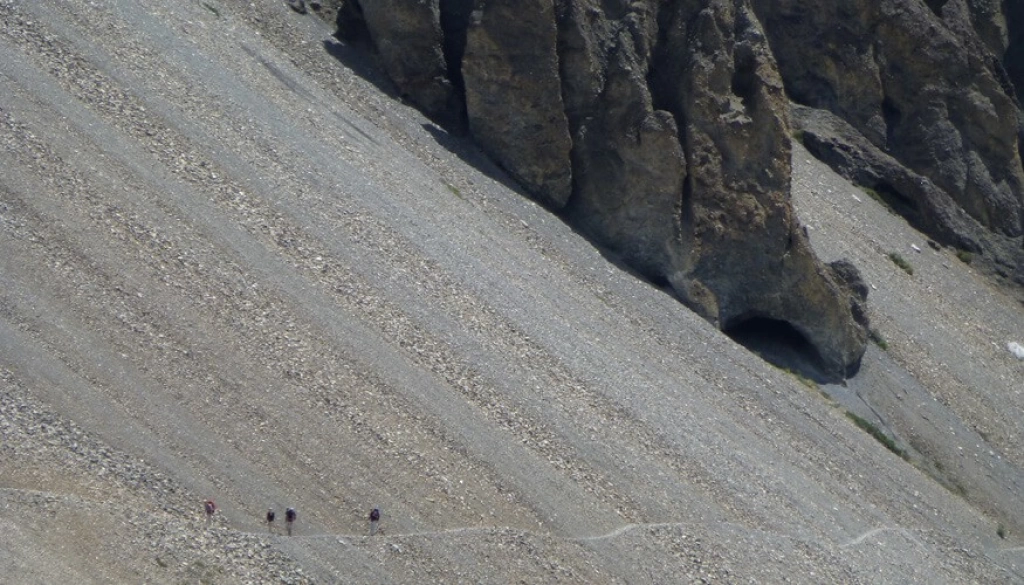
Our approach to base camp follows the Annapurna Circuit Trail up the beautiful Marsyangdi valley to the villages of Manang and Khansar affording an excellent acclimatization over about 10 days.This approach is also simpler logistically.

(An optional time-saving route is to fly directly to Jomsom in the Kali Gandaki Valley and climb over the Mesokanto Pass, 5300m to Base Camp in 3 days.This option allows little time for acclimatization.)


Tilicho Peak Climbing Route:

Tilicho Peak Base Camp, 4800m, is located on the Northwest end of the lake, a beautiful place to rest and acclimatize. Marine fossils found around the lake suggest that the Himalayas were once beneath the sea. Lake Tilicho is our water source.The water should be filtered or purified by iodine tablets or boiled.There are two high camps on the Tilicho Peak route.

The climb from Base Camp to Camp I, 5795m, on a shelf below the Northwest shoulder is straightforward. The route crosses a big (1.5km) snow field and then climbs on 50 degree mixed rock and ice for about 690m. From Camp I we enjoy the view of Tilicho Lake down below. The first trip is for acclimatization, and to take some camping gear up to Camp I. During the second ascent to Camp I, we stay overnight.The next day we climb to Camp II.

Camp II, 6200m, sits on the shoulder. The ascent to Camp II crosses a 700 meter snowfield of 55 degrees leading up to the shoulder. Fixed rope is required because of the angle, but luckily the width of the shoulder means there is low objective danger. We stay overnight at Camp II; if the weather is good we attempt the summit. If not, we return to Base Camp to recover and prepare for our next summit push.

The route to the summit of Tilicho Peak, 7134m continues on the wide shoulder. Though there is little exposure, the challenge is to cover the 800-900m snowfield with 55-60 degree slopes with as few stops as possible, reducing the risk of avalanche.

  1. the end of the expedition most people choose the shortest option, over the Mesokanto Pass to Jomsom which takes only one day. From Jomsom we can fly to Pokhara.

A three day option is to follow the Annapurna Circuit Trekking Trail via Thorong La pass, 5416m and fly out of Jomsom.

Allowing 16 days for the climbing period accommodates the acclimatization process and adverse weather conditions, leaving us ample opportunities to make the summit push.
 

Planning to climb Tilicho Peak in Nepal !!

Guaranteed Departures.. Please get in touch for further details.
Highlights of Tilicho Peak Expedition

  • technically interesting and challenging 7000m climb
  • incredibly beautiful location by Tilicho Lake
  • few climbers on the mountain
  • culture of remote traditional villages similar to Tibet
  • test your high altitude climbing skills on this mountain
  • trek and climb with our experienced Sherpa Climbing Guides
  • well set up camps and logistics in the mountain

Itinerary

Expand All Collapse All
Day 1: Arrival in Kathmandu 1,300 m/4,265 ft

Flying to Kathmandu is in itself an exciting and memorable experience. On a clear day, you will get a panoramic view of the snow-capped towering peaks. After completing the visa formalities in airport, collect your luggage downstairs. As you exit the airport terminal, you will be welcomed by one of our representatives carrying your name on our company’s’ signboard, Annapurna Foothills Treks & Expedition. Moving forward, you’ll be taken to your hotel in our vehicle. Once you reach at hotel, you’ll be welcomed by them as well and after that you can relax in your room or go for a walk exploring the city.

  • Hotel
  • Breakfast and welcome Dinner
  • Hotel

Today, we will start by early drive from Kathmandu to Dharapani. The road leads us West following the Trisuli River, then branches off the Pokhara highway, going North alongside the Marshyangdi River. Normally, we arrive at Besisahar in the early afternoon and then we will take a private jeep to reach Dharapani. We will follow the Marshyangdi Valley all day.

  • Breakfast, Lunch & Dinner
  • Tea House/ Lodge

An uphill journey takes us to the village of Chame known for its hospitality and spectacular views. This will be your first chance to take in panoramic views of Annapurna II, III and Lamjung Himal.

  • Breakfast, Lunch & Dinner
  • Tea House/ Lodge

From Chame to altitudes over 3000 meters, you will notice the surrounding changing as natural trees and plants become more scarce as the terrain begins to shift to a drier more desert like environment.

  • Breakfast, Lunch & Dinner
  • Tea House/ Lodge

We are now in the dry and arid region of Manang called Nyesyang. This area falls in a rain shadow area of the Himalaya where it seldom rains in the summer months; though it snows in the winter and the snow remains on the ground for a long time. The local people are mostly farmers and traders. There are two routes leading out of Pisang towards the Manang Valley. We take the one which follows the left bank of the valley floor. Today we will enjoy magnificent views of Annapurna III, IV, Gangapurna and the Tilicho peaks. At Hungde, we cross the river and walk along a fairly broad trail through the buckwheat and potato fields to the village of Braga, famous for it's monastery which is more than 500 years old. Then after a slight climb we arrive at the village of Manang.

  • Breakfast, Lunch & Dinner
  • Tea House/ Lodge

This is an ideal place to stop and spend the day around Manang for many reasons. First, we want to acclimatize to the altitude and to conserve our energy to succeed in our endeavor. Second, this is the part of the trek where we are closest to the mountains. Most people climb the hill behind Manang to enjoy the magnificent views of the whole Annapurna range and the enormous icefall that crashes and rumbles down from Gangapurna. The sunset and sunrise over this natural amphitheatre is one of the most beautiful mountain views in this region.

  • Breakfast, Lunch & Dinner
  • Tea House/ Lodge

Today, we will trek to the village of Shree Kharka from Manang. On the way, we can make a detour to a small lake at the Gangapurna glacier. There are about 70 houses in Khangsar as well as a monastery named Tore Gompa. From the village, there are superb views up the Khangsar Khola to Tilicho Peak and the Grand Barrier.

  • Breakfast, Lunch & Dinner
  • Tea House/ Lodge

In between Tore Gompa and Tilicho Lake, there is a big, grassy field where blue sheep are often seen. About one kilometer from the field, we reach a hill from where we will get a view of the entire valley. A steep descent will bring us to Tilicho Base Camp where we find our lodging for the night. 

  • Breakfast, Lunch & Dinner
  • Tea House/ Lodge

If weather conditions are favorable, we’ll make our day trip to Tilicho Lake, claimed to be the highest lake in the world at 5200m. The lake is 4 km long and 2.5 km wide. It is the main water source for the Marsyangdi River. We’ll have a picnic lunch before returning to the lodge.

  • Breakfast, Lunch & Dinner
  • Tea House/ Lodge
  • Breakfast, Lunch & Dinner
  • Camping
  • Breakfast, Lunch & Dinner
  • Camping
  • Breakfast, Lunch & Dinner
  • Camping
  • Breakfast, Lunch & Dinner
  • Tea House/ Lodge
  • Breakfast
  • Hotel
  • Breakfast
  • Hotel
  • Breakfast
  • Hotel
  • Breakfast

What's Included

Accommodations

  • Kathmandu (4 Nights): Standard tourist hotel on a twin-sharing basis with breakfast
  • Teahouse (12 Nights): Twin-share rooms with comfortable foam mattresses and pillows
  • Camping (13 Nights): Tents at Base camp, High Camp,
  • Camping Gear Provided: Tents, Mattresses, and kitchen equipment

Meals & Drinks

  • Teahouse Trek: 3 daily meals included (Breakfast, Lunch, Dinner)
  • Camping: 3 daily meals + boiled water, tea, and coffee included
  • Welcome Dinner: Authentic Nepali dinner with a live cultural show
  • Trail Energy: Free chocolate bars (Snickers, Mars, Bounty) for the climb
  • Fresh Fruits: Seasonal fruits served regularly throughout the trek

Transportations

  • Airport Transfers – All international and domestic airport transfers are included and operated by private tourist vehicles
  • Overland Journey – Travel from Kathmandu to Besi Sahar and Dharapani by private jeep. After the expedition return from Jomsom to Pokhara and onward to Kathmandu by fly

Guides and Climbers Ratio:

  • 1 Climber:1 Sherpa Climbing Guide

Guide and Staffs

  • Sherpa Climbing Guide
  • Cook and Government Liaison Officer
  • Porters: 1 Climber: 1 Porter
  • Necessary Camping Staff and Porters
  • Wages, accommodation, meals, and insurance

Base Camp Services

  • Single sleeping tent for each member
  • Foam mattress and pillow provided
  • Dining tent
  • Solar panels available for lighting and battery charging

High Altitude Tents, Equipment’s and Foods

  • High-altitude cooking pots
  • Gas burners and EPI gas for meal preparation
  • High-altitude sleeping tents provided at all camps, two members will share one tent
  • High-Altitude Nutrition – Special high-energy meals designed for climbing and high-altitude conditions

Benefits and Takeaways

  • Annapurna Foothills Treks duffel/kit bag 85 liters, trekking map
  • Annapurna Foothills Souvenir
  • Tilicho Peak Expeditions Summit Certificates

High Altitude Supports

  • First aid medicine kit
  • Supplementary Oxygen Cylinder with mask regulator
  • Thuraya Satellite phone for logistical, safety, and personal emergency use only
  • Walkie-talkies for effective communication between guides, climbers, and Base Camp
  • Insurance covers Rescue Evacuation and medications for all Nepalese staff
  • Pulse Oximeter (Oxygen Meter) to monitor your oxygen level, pulse rate, and heart health during your trip
  • 24/7 helicopter rescue assistance for medical emergencies (covered by your travel insurance)

Group Climbing Gears

  • Climbing rope
  • Ice screw
  • Snow bar
  • Ice Hammer

Permits & Taxes

  • Tilicho Peak Expeditions Climbing Permit
  • Annapurna Conservation Fee
  • TIMS (Trekkers’ Information Management System)
  • All administrative expenses and government taxes

What’s Excluded

What’s Excluded

  • Your Personal Travel Insurance
  • Nepal Entry Visa (Valid passport forat least six months)
  • International airfare
  • Lunch & Dinner in cities - allow $ 10 to $ 14 per meal in Tourist restaurants
  • Beverages (all drinks, mineral water, boiled water, and beer)
  • Tips for the guide, porters, and driver (customary)
  • Any personal expenses not mentioned in the above services
  • Additional night accommodation in Kathmandu because of early return from the trek (for any reason) than the planned itinerary


Tipping Guidelines

Tipping is a customary way to show appreciation for the hard work and dedication of our expedition support team

  • Base Camp Support Cook and Staff– USD 100–120 per person (for helpers staying at Base Camp)
  • A Porter: USD 200–300 (One personal porter per climber from Lukla to Base Camp and back, carrying up to 25–28 kg of luggage.)
  • Climbing Sherpa (Summit Bonus) – USD 700–1000 (for supporting you to the summit and back safely)

These amounts are recommended guidelines and can be adjusted based on your satisfaction with the service


Departure Dates

FromToStatusPrice  
Start Date06 Oct, 2026End Date05 Nov, 2026AvailableUS$ 8000

Departure Note:

Guaranteed- We already have trekkers booked for those dates and you can join the group.

Available - The date is available to book and once you confirm your trip it will be guaranteed.

Limited - The departure date is filling fast and only limited seats are available to join.

Closed- The Trip cannot be booked on that specific date. Contact us for customized dates.
 

The departure dates are your arrival dates in Nepal.


We have set dates for departure to the Tilicho Peak Expedition. So, pick your preferable date and let the adventure begin.

If the date you prefer is not listed on our departure dates then you can contact us directly to book the trip on your own desired date.

We have listed the price up to 04 trekkers at maximum. If you are more than 04 trekkers, then please feel free to contact us for amazing discounted group price and further booking process.

Private Trips to Tilicho Peak Expedition is possible. Contact us to design your own private trips with you loved ones.
 

Useful Info

Why Climb Tilicho Peak with Annapurna Foothills Treks and Expedition ?

  • Annapurna Foothills Treks and Expeditions a Nepal-based owner operated company who can make your dream of reaching the summit of Tilicho a reality for a reasonable price
  • It is the perfect option for experienced, confident climbers want high quality services without the pricey sophisticated and nonessentials offered by international operators
  • Annapurna Foothills Treks and Expeditions does not compromise safety
  • We use only the best quality equipment in the market
  • We take care of details of your expedition which will help you keep both comfortable and healthy
  • One veteran Sherpa climbing guide accompanies each climber to allow maximum flexibility. Each climber can take advantage of a window of good weather and personal climbing pace
  • Our Sherpa Climbing Guides are veterans of multiple 8000 meter summits.


The best seasons to do the Tilicho Peak Expedition are in the Fall, from September to November, and in the Spring from March to May.
 

Return to Kathmandu by Helicopter:

At the end of a long expedition, a quick flight by helicopter from Base Camp to Kathmandu is quite appealing.

Helicopter flights are available at the climbers own expense. The cost depends upon number of members in the group.
 

Oxygen and Medical

We carry top quality oxygen as well as oxygen mask and regulator for medical emergencies. We carry a comprehensive first aid kit throughout the expedition. Our guides are certified in first aid for high altitude. We carry a Gamow bag during the trek up to Advanced Base Camp, where it will be kept during the climb.